

HVOF Tungsten Carbide Coating – Process, Thickness and Selection
Tungsten carbide thermal-spray coatings are considered where a working surface needs resistance to abrasive or erosive wear. The coating combines hard carbide particles with a metal binder and is applied to a supporting substrate. Its behavior depends on the complete powder composition and the deposition and finishing route.
For a NUOPIN component enquiry, identify the substrate, wear mechanism, operating environment, coated areas and final dimensions. HVOF capability, coating qualification and any required testing must be confirmed for the particular part; this technical guide does not imply a dedicated in-house spray line.
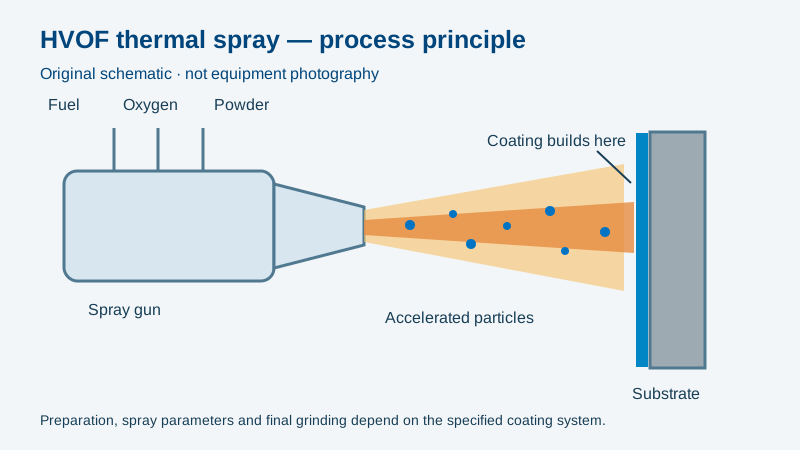
HVOF process illustration.

Existing gear component used to illustrate a wear-related part; no tungsten-carbide coating is claimed for this image.
Planning a Tungsten Carbide Coating Project with NUOPIN
- Review the component drawing and define the areas exposed to wear.
- Specify the substrate grade, hardness and condition before coating.
- Define the powder / binder system and any mandatory coating standard.
- Include finished size, roughness and grinding allowance.
- Agree inspection evidence and documentation before processing.
- Review quantity and delivery requirements as part of the quotation.
What Is a Tungsten Carbide Coating?
A sprayed tungsten carbide coating is usually a composite surface: hard WC particles are held within a metallic binder such as a cobalt-based or nickel-based system. The binder composition affects toughness, corrosion behavior and the usable environment. The substrate must support the coating under the expected contact loads.
Properties to Evaluate
- Resistance to the actual abrasion or erosion mechanism.
- Coating cohesion and adhesion to a prepared substrate.
- Binder compatibility with the operating fluid or atmosphere.
- Porosity, surface finish and the effect on the mating component.

Machined steel part example; coating performance is specified independently.
What Is HVOF Tungsten Carbide Coating?
High-velocity oxy-fuel spraying uses combustion and a high-speed gas stream to heat and accelerate a selected feedstock toward the component. Particles impact a prepared surface and build a coating through successive passes. The process must limit undesirable changes to the carbide and control the substrate temperature; it is not simply a matter of melting all the carbide.

Existing precision steel component illustrates the importance of fitted surfaces; image is not an HVOF result.
Advantages of a Suitable HVOF Coating
- A dense coating can provide a useful wearing surface.
- Controlled particle velocity and thermal input support the intended coating structure.
- Selected powder systems combine hard particles with a binder suited to the environment.
- The finished surface can be ground or polished for a defined interface.
An as-sprayed surface is not automatically smooth enough for a seal or precision fit. Required finishing and the coating thickness left afterward belong in the initial specification.
Thickness of HVOF Tungsten Carbide Coatings
Specify the finished coating thickness around the wear duty, substrate support and geometry. A thicker layer is not always more durable: coating stress, edge conditions, thermal expansion mismatch and adhesion influence the practical limit. A thin layer can also fail to provide the required finishing allowance or wear reserve.
- Distinguish the deposited thickness from the thickness remaining after grinding.
- Define coverage and thickness at the significant surfaces rather than assuming all recesses are accessible.
- Allow for edge transitions, masking and areas where the spray cannot reach at a suitable angle.
- Confirm the permitted range with the selected powder and application procedure; no universal thickness window is promised here.
How Is the Coating Applied?
- Prepare the substrate: clean it and establish the specified surface profile while protecting uncoated features.
- Apply the selected powder system through a controlled spray sequence that manages coverage and heat input.
- Allow the component to reach the required condition and check coating integrity before finishing.
- Grind or polish as specified, then verify final dimensions, roughness and coating acceptance requirements.
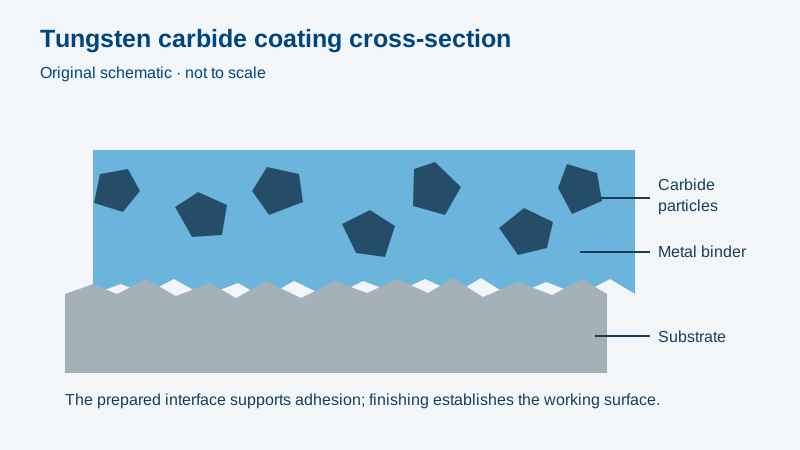
Simplified coating cross-section, not to scale.
Applications of Tungsten Carbide Coatings
- Mechanical and automotive wear interfaces where the selected coating suits the load.
- Pumps, valves and fluid-handling components exposed to erosive media.
- Mining and mineral-processing parts subject to severe abrasion.
- Metalworking and tooling surfaces where coating support and edge condition are suitable.
- Selected construction and heavy-equipment wearing surfaces.
- Food-processing or other controlled applications only after compatibility and cleanliness requirements are reviewed.
Tungsten Carbide and Chromium Carbide Coatings Compared
Choose the coating around temperature, wear mechanism and binder chemistry. Carbide identity alone does not determine corrosion resistance, adhesion or total cost.
- Wear: tungsten-carbide systems are commonly considered for severe abrasion and erosion in a suitable temperature range. The actual particle and binder combination matters.
- Temperature: chromium-carbide / nickel-chromium systems are often considered at higher temperatures than conventional WC systems. Do not assume tungsten carbide always has the higher usable temperature.
- Corrosion: binder composition, porosity and the environment are decisive; neither carbide family is universally superior in every fluid.
- Bond and support: surface preparation, substrate strength and process control govern coating integrity. A bond coat is a design choice, not an automatic requirement for every WC coating.
- Finishing: both systems may require controlled grinding or polishing. Check the achievable final size and roughness with the selected coating.
- Cost: compare feedstock, coverage, preparation, finishing and inspection as a complete route, rather than ranking only the raw powder.
The process descriptions explain selection options, not a guarantee for every alloy or part. Send the drawing, material grade, quantity and finish specification through Contact Us so the applicable process and inspection requirements can be confirmed.
Technical reference: Oerlikon Metco — tungsten carbide coating materials. View all finishing processes.

